
 From my associate Grant Tate.
Last week I went to a bank—a real one. You know, those small roadside office-like businesses, with a huge corporate logo on top and a couple of drive-up or stand-in-line automatic teller machines. There was a small door signaling, “If you actually don’t know how to use an ATM, enter here.” The ATM didn’t like my bank card, so in the door I went.
There were five small doorless offices along the wall on my left, each with a bank employee leaning over talking to one or two persons seated across the desk. A quiet murmur indicated they were actually talking. Several black stock leather chairs formed a line in front of the offices, empty now. Apparently, no one was waiting.
A line of five teller windows formed a barrier on my right. A row of Disneyworld rope paths led to two of the windows; one labeled for business customers. Five people were lined up in the unlabeled line waiting to be served by a live teller. There was no one in the business line, nor was there a teller at the window. More people were joining the line.
After waiting for fifteen minutes, I went to the business window and found a holder with a banker’s calling cards. I dialed the number on the card and listened to the expected voicemail on the other end. I left my own voicemail: “Hey, I’m at the business window and I’m wondering where you are. We are waiting for service here. Please call me back.” (It’s a week later, and I never received a call.)
Eventually, I made my way to the only teller, cashed my check, and left the lobby and the grumbling people behind.
A real person is required when the bank’s monstrous electronic system is incapable of performing a needed chore, big or small. And, in the past year, every interaction has been a time-consuming, irritating experience. I’ve considered changing banks, but that is an administrative hassle. And would the next bank be better?
That is the trillion-dollar question. Would the next bank be any better?
Probably not. Because the modern mega-bank isn’t designed for people. It is a sprawling, invisible electronic entity. It lives in the cloud, governed by an unseen cadre of technocrats and executive managers. They sit in glass towers, staring at KPIs and efficiency spreadsheets, entirely disconnected from the human being crying for service on the street below.
To them, a human customer is an anomaly. A system glitch.
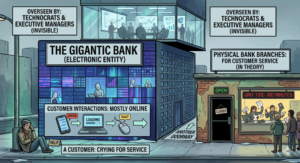
They build massive digital fortresses and try to force everyone through the same narrow electronic gateway. It works beautifully—until it doesn’t. And when the app freezes, the ATM rejects a card, or a fraud alert locks an account, the customer is told to seek out that “other doorway”: the physical branch.
But when you walk through that doorway, you find a ghost town.
The technocrats have gutted the branches to optimize the balance sheet. They leave them so chronically understaffed that a simple check-cashing errand turns into a multi-hour standoff. The frontline staff aren’t to blame. They are drowning, caught between angry queues and impossible corporate metrics. The real culprit is the leadership team that viewed human interaction as an unnecessary expense to be eliminated.
There is a profound business lesson hiding in this misery.
When you automate your business, you cannot automate the empathy. Technology should be a bridge to your customer, not a moat to keep them out. If you reduce your customer service to a series of rigid algorithms, you lose the ability to handle the exceptions. And in business, the exceptions are where loyalty is either won or lost.
If your digital systems fail, your human backup needs to be flawless, fast, and accessible. Otherwise, you aren’t saving money. You are just bankrupting your brand’s reputation, one ignored voicemail at a time.