
NYC Executive Coaching Logo

Results Driven Leadership Development

NYC Executive Coaching Logo

Results Driven Leadership Development

  • Home
  • About
    • Our Approach to Executive Coaching
    • Our Clients
    • Our Coaches
    • Client Success Stories
    • Our Locations
    • Our Values
    • Our Affiliations
  • Our Services
    • Executive Leadership Development
    • Fast Track Leadership Development
    • CEO Coaching
    • Sounding Board Coaching
    • Executive Talent Assessment
    • Time Management Coaching
  • Blog
  • Contact
  • Home
  • About
    • Our Approach to Executive Coaching
    • Our Clients
    • Our Coaches
    • Client Success Stories
    • Our Locations
    • Our Values
    • Our Affiliations
  • Our Services
    • Executive Leadership Development
    • Fast Track Leadership Development
    • CEO Coaching
    • Sounding Board Coaching
    • Executive Talent Assessment
    • Time Management Coaching
  • Blog
  • Contact

Category Archives: Executive Coaching

Transitioning From An Entrenpreneurship To a Professionally Managed Firm Part I

NYC Executive Coaching avatarPosted on July 13, 2022 by Doug BrownAugust 17, 2022

Editor’s Note: This is the first installment of an ongoing series surrounding what it takes to move from a relatively small micro-business to a more robust, larger organization. Each article will explore a different aspect of this journey.

Starting with the most basic premise, entrepreneurs typically face the initial challenges surrounding creating a new venture from scratch or building up a recent acquisition. Their ability to recognize and act on the marketplace’s needs will help determine growth rates at every step of the business’s lifespan.

When they are successful in the dance of meeting and matching the market’s needs and customer base, the business begins its positive movement along the growth curve. Almost every step up the revenue ladder brings additional challenges. You can hear the questions that people ask themselves: “Do we have enough people, space, equipment, and working capital to get through this period while stretched so thin? Am I calling it too close? What should I do first? What can we do to get the production and productivity levels up to meet the needs of the business?” Hectic describes the feeling on most days and frenetic more times than someone cares to admit.

What are the common symptoms that accompany this phase of growth? There is precious little time spent on thinking and very little planning usually occurs. Despite this obvious flaw, every time they experience a positive feeling (adrenaline or euphoria), this wrong behavior gets reinforced.

What has been described by Eric Flamholtz, Ph.D., a UCLA professor, as “organizational growing pains” can be articulated as follows:

  • People feel there are not enough hours in the day
  • People spend too much time “putting out fires”
  • Many people aren’t aware of what others are doing
  • People lack an understanding of the firm’s ultimate goals
  • There are not enough good managers
  • People feel that “I have to do it myself if I want it done correctly”
  • Most people feel that the firm’s meetings are a waste of time
  • Plans seldom are made and even more seldom followed up, so things often don’t get done
  • Some people feel insecure about their place in the firm
  • The firm has continued to grow in sales but not to the same extent in profits


The chief executive officer or founder must recognize that these symptoms indicate underlying problems that will only worsen unless met head-on. A transformation (or metamorphosis) is necessary. The business must evolve from its traditional freewheeling, anything goes, random behavior patterns that scream “we’ll figure it out as we go along” to a more organized, disciplined, and thoughtful approach. The movement from being reactionary to proactive must take place.

This next phase requires carefully defining position descriptions and job responsibilities. Minimize job overlaps. Increase accountability within goals, measures, and standards of performance. Invest both time and money to go from only on-the-job training to a more formalized approach to people development as a precursor to installing rewards and recognition programs, performance appraisals, and more formal staff and management development processes. Look at the business from a dollars and cents point of view. Require the creation, adoption, and management of a budget to ensure the right things get appropriately funded while the wrong things get weeded out. There must be reports available to show progress or lack thereof. Annual profitability measures become a target to be achieved rather than just a by-product of “I guess we guessed right, and this is what is left over.”

For an entrepreneur, this can be a particularly trying time. Some of the very traits that helped spur the organization in its early days can lead to its faltering or demise. Looking at some typical characteristics, most entrepreneurs:

  • Will have either a sales or technical background
  • Know the industry well
  • Want to have things done their way
  • May be more intelligent than many of the staff they tend to hire
  • May be more likely to trust their own instincts versus taking the time to seek out the research or the numbers
  • Attract subordinates who begin to rely on their boss’s bravado and confidence that they are all-knowing
  • Are likely to be “do-ers” rather than managers
  • Are likely to be self-taught readers versus undergoing a lot of formalized ongoing training.


The next big challenge for entrepreneurs

Many entrepreneurs are likely to abhor any trappings of what they view as restrictive corporate behavior. Therefore, they don’t like to schedule staff meetings, be accountable for their time organization or have to operate within a budget. It is easy for them to fall into the trap, thinking, “So far, we have gotten along just fine without these things.”

At this stage of the firm’s growth and development, the very nature of the firm itself probably has changed. Over time, it has begun its transition into this larger enterprise. Now the management team has to change along with it. Fortunately for those reading this article, pathways have already been selected and tried by other leaders and owners. They have taken one of the following actions:

  1. Doing nothing and hoping for the best.
  2. Undergoing personal and professional growth. Taking it on as a challenge to develop the attitudes, skills, knowledge and positive behavioral changes needed to continue to lead the organization effectively.
  3. Resigning and bringing in a professional manager to run the organization.
  4. Moving up to the role of chairman, as Steven Jobs and Bill Gates did, and allowing the professional managers to run the day-to-day while staying somewhat involved.
  5. Selling out and starting another firm back at the entrepreneurial level.
  6. Merging or being acquired by another firm with the additional infrastructure in place.


Research bears out that many founders and entrepreneurs have an extraordinarily difficult time giving up control of their business. In many cases, they have poured their life’s work into building that business, and it is as much a part of them as is their right arm and hand.

Owners face the challenge of even considering that someone else may be able to run their organization as well as they can or improve performance levels. As a result, they hold on with all their strength. Their organization ultimately becomes a victim of the “potted-plant syndrome.” That is where the size of the pot determines how far the plant can grow before it becomes root-bound and stunted. In the worst cases in nature, the plant strangles itself and dies prematurely. I have observed that the leaders’ self-imagery and self-concept will only let the firm grow so big or grow so fast in the business world. Whenever they are so afraid of losing control, they fail to act on the opportunities of a lifetime. Or they fail to pull the trigger promptly. When this occurs, their firm is almost guaranteed not to be awarded or accepted for the contract or policy. This fear of success plays out in leaders’ minds as, “We are not worthy to receive this level of recognition or success on such a large scale, and therefore we will blow this opportunity to prove to others that we aren’t really that good.” If you have ever heard of someone who is typically very reliable missing a deadline on a game-changing opportunity, keep this lesson in mind.

Others attempt to undergo this transformation by acquiring the appropriate skills and attitudes—but never really get it for any number of reasons.

Some owners will go through the motion of bringing in managers and leaders from the outside and then stand around and watch as they suffer and fail miserably. My observations of leaders have witnessed several common tactics exhibited. The founders unconsciously don’t want to be “shown up” by the others they have brought in. That might make them seem to have been wrong (or less effective) in the past; they behave in specific ways. For example, they conveniently forget to tell the new manager about a critical deadline or a particular way of handling a long-term customer’s unique requests. In the end, they get chastised and embarrassed. They may also undermine their new manager’s authority when dealing with some long-term employees. Even though they had told the new manager, they wanted something to be taken care of or fixed.

They don’t give them all the information needed to do the whole job up front. When this happens, the new manager cannot finish the task without coming back to ask the owner for their help- making them appear less effective or competent. Others have described it as creating managerial eunuchs.

Eventually, they tell their staff: “However reluctant I am to get involved here, I better do it because I need to save you guys.” It is a form of the “Messiah complex” played out live and in living color.

Whatever the form of transition to be undertaken, it is paramount that all recognize that the organization has changed since the early days and can’t go back without severe consequences.

In the following installments, we will explore the predictable stages of organizational growth and the developmental items and tactics to address in each phase. For example, future articles will cover:

  • The six critical organizational development tasks
  • The four different stages of growth
  • Determining and assessing the usual growing pains
  • Planning the transitions that leaders must successfully execute


Watch for the next installment.

Posted in Executive Coaching, Leadership Development | Tagged Entrepreneurship

Meeting Overload IS Getting Worse

NYC Executive Coaching avatarPosted on June 15, 2022 by Doug BrownJune 15, 2022

Meeting overloadTo put things in perspective, in the 1960s executives spent about 10 hours/week in meetings. By 2017, that number ballooned to almost 23 hours a week on average. According to The Atlantic, since the start of the pandemic, with more people working remotely, the number of online work meetings has more than doubled and continues to increase.
“People have 250 percent more meetings every day than they did before the pandemic,” said Mary Czerwinski, the research manager of the Human Understanding and Empathy group at Microsoft. “That means everything else—like coding [work] and email and writing—is being pushed later.”

Because of this huge increase in meetings, people are losing time for their own individual work, leading people to work longer hours, The Atlantic reports. According to research from Microsoft, the average workday has increased by 13%, or around an hour, since March 2020, and the average length of after-hours work has increased by twice as much.

Do you REALLY need to have that standing meeting? If so, always make sure the value of the juice is worth the squeeze.

Posted in Executive Coaching

Spending More Time in Quadrant II

NYC Executive Coaching avatarPosted on April 13, 2022 by Doug BrownApril 13, 2022

From my associate, Ellen Nonemaker.

Stephen Covey – Habit #3

“Things which matter most – Must never be at the mercy of things that matter least.”
Goethe

Spend More Time in Quadrant IIFor years I have been a great fan and follower of Stephen Covey. The Seven Habits of Highly Successful People* was first published in 1989 and has been published numerous times since. It has been my bible in book form, cassette tapes, and now CDs. Repetition, we know, is one of the best ways to learn – and with a career that requires a lot of travel, listening and learning are natural ways to pass the time.

Although learning and practicing all seven habits is important, I find that the one most difficult for many of my coaching clients to practice is Habit #3 – Put First Things First. In order to be successful at Habit #3, Covey stresses how essential and prerequisite Habits 1 and 2 are. Habit #1 – Be Proactive and Habit #2 – Begin with the End in Mind, give us the principles of personal vision and personal leadership. Habit #3 – Put First Things First, gives us the principles of personal management.

Many people struggle with time management and prioritizing, juggling busy personal lives and professional responsibilities, only to miss important meetings and memorable events – feeling frustrated and stressed. What Habit #3 gives us is the ability to understand “Self-management vs Time management”. Habit #3 provides the groundwork for a balanced life.

There are only twenty-four hours in every day and seven days in a week. Understanding that we don’t control time, but we can control how we use that time is key in avoiding the stress of multiple priorities. Having a TO DO list is great, but prioritizing that list is even more important. If we start at the top, we may not get to the more pressing task further down the list. Today, emails, texts, and cell calls can totally disrupt our focus, sometimes causing us never get back to our list.

Most businesspeople have been made aware of the Seven Habits, Habit #3 and the Covey’s Time Matrix** through classes, managers or coaches, but how many actually successfully apply these principles? Many of my coaching clients have difficulty with “time management.” They look to me to help them create a system. They will always struggle and be frustrated until they understand that it is not “time” but their activities that need management. Until they learn to take time for themselves to learn and refresh, they will be stressed.

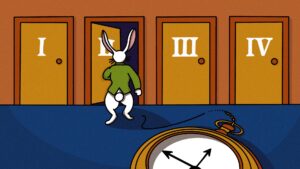
We all know someone like the White Rabbit in Alice in Wonderland, continuously checking their watch and exclaiming. “I’m late, I’m late, for a very important date!” The White Rabbit spends most of his time in Quadrants I or III, where everything is Urgent – whether or not it’s Important. Step back and prioritize our daily, weekly, monthly, and even yearly activities. React to less critical matters, saying “no” to things that don’t fit our purpose, while focusing on those activities that move us forward give us the greatest reward.

Spending time in Quadrant II means planning, strategizing, and being creative. We are doing important things that are not urgent now and key to our future. If we spend more time in Quadrant II, we will eventually spend less time in Quadrant I. We can create a window for genuinely urgent matters, like a sick parent or child or unforeseen pressing problems.

As we progress throughout the year, reviewing our Time Matrix and scheduling time for Quadrant II activities can be a vital step. We will be channeling our efforts for more positive results while creating less stress and greater balance.

*Covey, Stephen R., The 7 Habits of Highly Successful People, The Free Press, New York

**Quadrant I – Urgent & Important
Quadrant II – Important, but Not Urgent
Quadrant III – Urgent, but Not Important
Quadrant IV – Not Urgent & Not Important.

Posted in Executive Coaching | Tagged executive coaching

If You Want a Different Outcome You Need To Do the Hard Stuff

NYC Executive Coaching avatarPosted on November 9, 2021 by Doug BrownNovember 9, 2021

You Gotta Do the Hard StuffSubmitted by Janice Giannini.

I recently read the Middle Market Growth’s special report titled Future of Work 2021. The report addressed post-pandemic realities across several dimensions: the future of work, productivity, strategies for managing a mobile workforce, technology game-changers, the future of logistics, a focus on mentally healthy employees, and technology and ERP systems.

A section entitled “Focus on Mentally Healthy Employees” addressed the transitions to work from home or hybrid model from the traditional in-office model. The narrative in the report focuses on what the company needs to do. I think this section is missing a big point here. The employees, who always depended on someone else to manage their time and life, now regulate their own lives in this new model.

Many people, not all, may not recognize this or have the skills or desire to do so. It’s the hard stuff of life. And many people try to avoid the challenging and uncomfortable aspects of life.

The ones who succeed in life (based on their definition of success) are the folks who step up, identify the hard stuff, face it and do something about it.

If the industry thinks that employers can improve employees’ health by themselves, it will never happen.

People may be tired of hearing the word accountability. Personal accountability is what will get them through this and enable them to thrive in the future.

Mahatma Gandhi’s quote, “I suppose leadership at one time meant muscles; but today it means getting along with people” has never been more true. In order to get along with people, you need to know yourself and be personally accountable.

Posted in Executive Coaching, Leadership Development

The Upside of Time You Didn’t Have Before

NYC Executive Coaching avatarPosted on May 4, 2021 by Doug BrownMay 4, 2021

Authored by Janice Giannini.

When the stay at home orders came out last year, many of my friends and I were lamenting the:

  • Need to Zoom into every activity
  • Disruption to our lives, work, home life, social life, and fun activities
  • Lack of human contact
  • Uncertainty about the length of time we had to wait it out.


Hand in hand with thinking this is the worst thing that has happened to us was the question what do we do now? Suddenly there was more time on our hands to fill, use or invest in something. Clearly, we were not doing school at home with children. So what was that something to be?

Recently, I realized that I had received the gift of extra uncommitted time (lack of driving, traveling, etc.). I read. I invested in several online courses. I devoured almost 40 additional books last year because I had the time and attention to read.

What did I read?

In the past, I never found the time to understand the rational case for the Christian faith. I had read that the Bible is the world’s best-selling and most widely distributed book. Recent estimates suggest that as many as 5 billion copies have been purchased during the last 100 years.

So I went on a journey to understand why the Bible? And to develop a limited understanding of the comparison of Christianity to other religions.

The author, Charles Martin, wrote a book about the Bible titled, What If It’s True? That started me thinking.

As I look at the troubled times in which we live, the challenges we face in business, leadership, and society in general, the following thought occurred to me. If, indeed, there is a reason there are 5 billion+ copies of the Bible out there–what IF?

What if we applied the simplest tenets to business and leadership? What might be the difference in how we operate and the results we achieve?

What if–

  • Our default position was to try to understand others’ points of view first, before judging or trying to convince them our way is the right way?
  • We committed ourselves to be the first person to say I’m sorry we got off on the wrong foot. Let’s try this again?

Could it be easier to envision and realize the following?

  • Implement greater Diversity and Inclusivity
  • Demonstrate greater respect for all people
  • Develop greater trust among executives, employees, clients, and shareholders
  • Build sustainable solutions for the business versus focusing too much on short-term goals and Wall Street pressures


So, what do you think?

Is it worth some of your time to ponder as well?

Posted in Executive Coaching

Time to Strengthen Your Strengths

NYC Executive Coaching avatarPosted on April 27, 2021 by Doug BrownApril 27, 2021

“It’s impossible to wear out your gifts, because the more you use them the stronger they become.” – Dr. Dale Henry

Many of us are keenly aware of our weaknesses but struggle to identify our gifts or strengths. Furthermore, when prompted to think of something we want to improve about ourselves, many of us will more likely think of a weakness, not a strength.

Research shows that people who recognize and regularly use their strengths are more successful at work. As we increase our focus on developing our strengths rather than exclusively improving our weaknesses, we are happier and more fulfilled.

Not knowing real strengths often holds people back from reaching their full potential. As we identify each of our strengths and focus on them, we are more productive, perform better, are naturally more engaged. Greater joy in work and life can result.

One challenge is that as individuals, we don’t always objectively know what our strengths are. Even if you ask other people to describe your strengths, their answers may not be an unbiased view. Take the case of someone in an organization known as a go-getter, a hell-on-wheels type of person when it comes to getting stuff done, but who also burns through people.

How may this person’s performance be treated during a performance appraisal discussion? Here are two distinct scenarios.

  1. The person doing the review is also a super results-driven individual that loves the fact that this person gets great results. They may somewhat gloss over the fact that they have the highest turnover in the company – Your results are spectacular, and you are at the top of the company when it comes to getting results. And, oh yeah, you probably need to be a little more sensitive and careful when dealing with your people. That said, keep up the great work.
  2. The person conducting the review is empathetic. They might convey a message like this – While your results are great, it is unacceptable to have this level of turnover in our people. You need to turn this situation around, or you will be gone.

As you can see, these behaviors and outcomes, when viewed from two reviewers’ perspectives, yield very different career advice. Does this help explain why getting objective input is so challenging?

Getting clarity on individual strengths helps organizations put the right people into the best positions to set themselves and the organization up for success. When tying strengths and competencies into preferred behaviors (as measured by a DISC profile, for example), it becomes clear what job environments are best suited for each individual and which will require a high level of modification to achieve a fit.

When endorsed by leaders, a strengths-based focus delivers better outcomes for individuals, teams, and organizations.

Posted in Executive Coaching

Are You Engaging?

NYC Executive Coaching avatarPosted on May 2, 2019 by Doug BrownJanuary 21, 2019

Are You Engaging?

I know that is an unusual question to begin a business column. But in this case I am not referring to purely your personal style. I am referring to how well you engage everyone who works in your organization.

Employee engagement doesn’t have to be relegated to some soft-headed, everybody-feelgood-and-sing-Kumbaya moments. It can deliver pragmatic outcomes that most execs would die for.

Ben Zander, conductor of Boston Philharmonic Orchestra, speaks about the word symphony, which is derived from Greek συµφωνία, meaning agreement or concord of sound. He refers to it as sounding together.
Think about it. This means there is no more of the normal BS and distraction associated with “them and us” or “we and they” or “my area and your area.” It is just “us.”

Sounding together is a very powerful notion because without it, regardless of the talent of the players involved, the result is cacophony.

Scary Statistics

This lack of sounding together may result in American businesses only operating at one-third of their true capacity due to employee disengagement occurring within the workplace.

Gallup and Harris polls involving more than 10,000 employees across various industries indicate some potentially frightening findings. When reviewing the following points, consider the impact and implications on your organization’s top- and bottom-line financial performance, your ability to manage the business, your ability to achieve positive customer loyalty metrics and market share growth, and your ability to optimize the employee strengths in your organization:

  • Only 15% of the employees could identify the company’s most important goals.
  • 51% were unsure of how they were expected to help the company achieve goals.
  • Only 49% of all available work time is dedicated to companies’ most important goals.
  • 53% of American employees are unhappy with their jobs.
  • Only 29% of employees indicated they are fully engaged in their work.
  • 55% of employees described symptoms that point out they are disengaged from their
    work.
  • 16% of those surveyed indicated they are actively disengaged from their work.


Employee_EngagementLook closely. Only 29% of employees are truly engaged! That is the group that believes in the company and wants to make things better.  They clearly understand the business and how their work fits into the big picture. These employees are respectful of (and helpful to) team members and others, find opportunities to stay current in their field of expertise, and are willing to go the extra mile.

In contrast, disengaged employees are not risk takers nor committed to the company. They lack a sense of achievement in their work and advancement in their role is not important—they are just doing enough to keep their job. Actively disengaged employees are unhappy at work and act out the unhappiness. They like to be part of the problem and find it almost impossible to become part of the solution.

They spread discontent and consistently fall short of meeting performance expectations. Disengaged employees cause a significant loss in effectiveness and productivity. For example, if you have 1,000 employees with an average salary/benefits of $35,000, that adds up to $35 million per year. If your firm’s number falls somewhere between 33% and 71% for those that are not delivering a full hour of work for a full hour of pay, you are squandering somewhere between $10 million and $20.5 million in wages every year. That number does not even take into consideration how the behavior of those employees may have negatively affected the servicing of internal and external customers.

Without a doubt, every organization wants high performers who are talented, understand the business model and goals, perform above expectations, and model behaviors that influence others. These performers maximize
resources through creative insights—far greater than others—and produce high levels of results.

Low-performing employees who are actively disengaged abuse systems, disrupt interactions, and often become an obstacle to organizational effectiveness.  I believe an engaged workplace culture can be created and sustained when you consciously attract, hire, support, and develop people who look forward to using their collective talents, attitudes, habits, skills, and knowledge to benefit your internal and external customers.
This involves everything from setting clear direction and living your espoused values to invigorating organizational capability and capacity because you have truly mobilized individual commitment. For it to be real, it must be something that is as natural a part of your operation as breathing is to a human being.

So let me ask you again:

Are you engaging?

Posted in Communication, Executive Coaching, Leadership Development

Executive Coaching from a Butterfly

NYC Executive Coaching avatarPosted on October 27, 2018 by Doug BrownNovember 3, 2018

ButterflyA Lesson from Mother Nature

Nature provides an endless supply of lessons.  Ways for us to be more effective.  Allow me to share this one from the committed actions of the butterfly.  Press the PLAY icon and invest 90 seconds in developing your commitment.

What goals do you have that have been blown off course?  How does your commitment measure up to that of the butterfly?


Posted in Executive Coaching

The Self-Deluded Leadership Trap

NYC Executive Coaching avatarPosted on October 20, 2018 by Doug BrownOctober 20, 2018

Leadership TrapI have been observing people in power for quite a while, long before the latest public official made, shall we say, an error in judgment and came clean with the obligatory chest thumping and mea culpas.

It doesn’t matter whether you look at elected officials like Sanford, Blagojevich, Clinton, or Nixon or famous individuals such as Falwell, King, Jackson, Skilling, or Madoff, the underlying behavior is identical. What led to their public dressing down was their apparent belief that the rules of conduct that apply to other people somehow don’t apply to them.

Prior to their meltdown, we were under the impression that these individuals were intellectually bright. Imagine how disappointed we would be, and how foolish they would look, if we discovered they believed that Newton’s Law of Gravity simply didn’t apply to them—that it was only for “mere mortals.”

Case Study

I have been watching a leader within an organization I know well who is in the process of being removed because of his ineffectiveness. The main cause of the coup is fairly straightforward. This leader no longer
views his behavior and communication style in the same manner as those on the receiving end of his mannerisms and diatribes. As one person put it, “he has lost the locker room.”

This leader is not normally mean-spirited or angry, but he doesn’t seem to understand that there is a price to be paid every time he spins out of control. He is consistently operating by only viewing his positive contributions as the scorecard on which he should be judged. He attempts to discount or dismiss away any indications that he doesn’t walk on water without the benefit of rocks underneath.

Whenever someone attempts to give him feedback on the perception of others as to the impractical nature of his ideas, he dismisses it with a simple twist and attempts to put the messenger on the defensive by asking why s/he is being so negative.

He obviously believes that a good defense is to play offense. The tactic hasn’t been appreciated by others, and they have stopped trying to talk with him entirely. It’s not worth the ensuing battle.

To many of those he is supposed to be leading, he is viewed as suffering from delusions.  In his world, everything is always going to work out smoothly because the initial idea was his. In the organization’s world, it doesn’t work out that way, and others must scurry around to try to avoid a disaster.

Often, as people rise to positions of power, the people who report to them stop telling them the truth. Sometimes it’s because those at the top don’t react well to bad news, so the messengers learn to act in their own best interest. Sometimes the person in power starts to believe that they are so wise and talented that there couldn’t possibly be anything that could go wrong and therefore indicate a flaw in their plan.

A Leader’s Pursuit of Truth

Keep in mind the dangers of having reports sanitized for your protection (as in the O-ring and NASA’s Challenger disaster). As a true leader, you must be strong enough to push the people on whom you depend to tell you the real truth, in its entirety. In your personal and professional lives, there is no substitute for being grounded in reality when you are making decisions and taking action. True leaders willingly read more than their own press releases, so to speak.

Be True to Yourself

My advice is this: to thine own self and other people be true. Not “kinda sorta” true. True. Self-deception and self-delusion are not hallmarks of great leadership. Indeed, we have seen these qualities take down entire organizations, regardless of size and history.  Are you willing to give up subterfuge for truth even when it isn’t pleasant to live through? I hope so. People in your life are counting on it.

Posted in Executive Coaching, Leadership Development

Exploring Our Fit is Easy

We invite you to connect for a confidential, insightful discussion.

Free Executive Consultation

Call (908) 578-2457

Our Leadership Blog

Leadership Insights for the Real World
NYC Executive Coaching Logo

NYC Executive Coaching is the Coaching focused business unit of Paradigm Associates, LLC

Paradigm Associates

Executive Coaching Services

  • Executive Leadership Development
  • Fast Track Leadership Development
  • CEO Executive Coaching
  • Sounding Board Coaching
  • Executive Talent Assessment
  • Time Management Coaching

Social Sharing

Some of Our Clients

Grant Thornton Logo
WSP Logo
Conti Logo Green
J-C logo
GUARDIAN_LOGO
Givaudan_logo
Goodman
Withum
YMCA Logo
Nabisco
Ferreira Logo
Miner-logo-header
PSEG
NJ-Biz
View Logo List

Client Success Stories

As Chairman of the Board, I recently had the opportunity to work with Doug on a strategic planning effort for the New York Society of Association Executives. Doug was terrific in working with Association leaders. His high touch, vast knowledge of planning skills and focus on critical success factors was invaluable.
Michael Weamer
Michael WeamerPresident & CEO - The Marfan Foundation
Doug is an incredible coach. His insight is invaluable, and his process is creative and productive. He has an ability to see things in others that they might never find on their own. I can't recommend him highly enough!
Kyle Althof
Kyle AlthofSenior Administrator, The Metropolitan Museum of Art
Doug is a great coach. He gets you to think outside of the box and gives great scenarios as well as his past experiences in order to expand your views. He is very insightful. The creative methods and ways of thinking he incorporates into his coaching are beneficial in both a business and personal sense. His guidance has proven to be effective and I often think back to our sessions when making decisions and setting goals.I would recommend Doug as a coach to anyone looking to learn and grow as a manager, professional, or person.
Lauren Hayes, CSP
Lauren Hayes, CSPArea Manager at Peoplelink Staffing Solutions
Doug Brown is a leading edge conceptual thinker, a leader who has the ability to develop practical solutions to complex problems. Doug knows that it’s the people who must implement solutions; so as a master coach, teacher, and facilitator, he helps world-class leaders achieve even higher levels of performance. When facing complicated problems, Doug is out front with new and creative approaches. His breadth of experience runs the gamut from sales to strategy to organizational culture.
Grant Tate
Grant TateChief Strategist - the bridge, ltd
Doug ‘s keen insight and intellect helped me navigate many difficult business and personal decisions. Doug’s mentoring approach has provided me with exceptional value and guidance.
Jeffrey Egol
Jeffrey EgolSenior Finance Executive
See More Success Stories

© 2018 - 2025 Paradigm Associates LLC All Rights Reserved